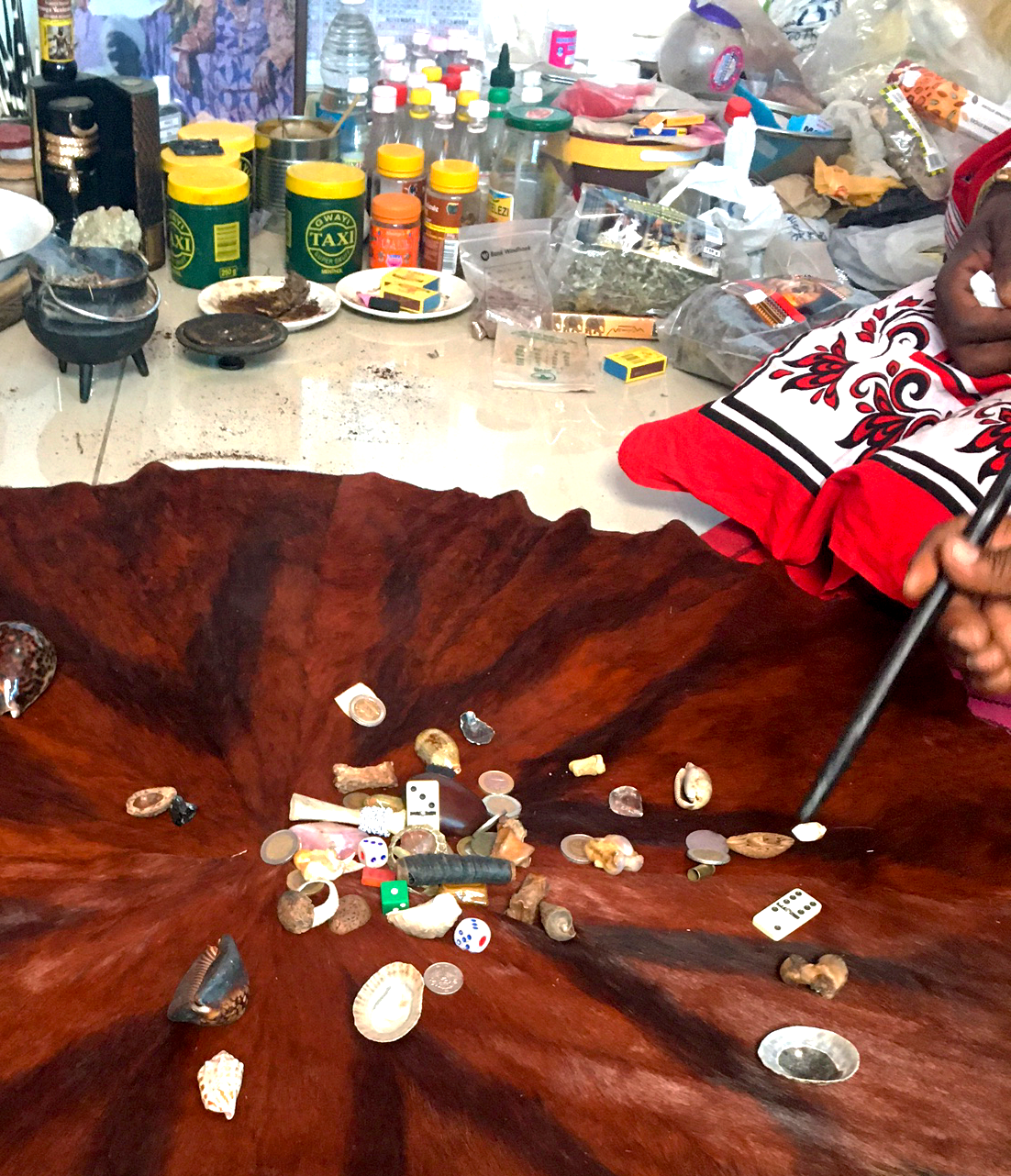
Hooker Magic and the power of knowledge in sex work
Abstract
This article examines the vernacular phrase hooker magic to explore the intricacies and depths of a particular subjectivity that emerges through (and from) sex work. Based on five years of ethnographic fieldwork with sex workers in London, this article explores the technologies of sex work, demonstrating the complex system of material, sexual and intersubjective practices that are inherent to the work.
Hooker magic is simultaneously a material practice and an interpretation of the cosmic-moral orders in which sex as work is undertaken. This bricolage phrase, and its variants, is used to make sense of the socio-political nuances sex workers exist in. Hooker magic encompasses the hope and conviction that despite the seeming elusiveness of socio-material wealth and protection, there is abundance to be tapped into, if only one is privy to the knowledge that permits one access. The commitment to hooker magic as a form of what Lauren Berlant calls ‘cruel optimism’ (2011) propels the sex worker to continuously renew their knowledge; to adapt, learn and (re)write their bodily and material techniques. Know-how or savoir faire is thus related in this article to how certain forms of knowledge become wisdom.
Centring the material and sexual practices that constitute the emic category of hooker magic, the article seeks to illustrate how knowledge relates to subject- and meaning-making that produces, and is produced by, this form of sex work.
Citation: Dominique, Chloe “Hooker Magic and the power of knowledge in sex work” The Jugaad Project, Vol. 7, No. 1, 2026, www.thejugaadproject.pub/hooker-magic [date of access]
Introduction
I did not go looking for hooker magic. My ethnographic interest was in how two important markers of citizenship – how we have sex and what we do for work – coalesce in the form of full-service sex work, and how through this labour practice, a particular subjectivity emerges. But, like many things that emerge unexpectedly in the field, hooker magic took on a salience in my analysis. Drawing on five years of ethnographic fieldwork with independent, indoor full-service[1] sex workers in London, this article explores the technologies of sex work, demonstrating the complex system of material, sexual and intersubjective practices that are inherent to the work.[2]
Sex and magic have long historical ties with spiritual and religious practices. Magic, in its indeterminate form, is used to signify what sex should be like, with ‘good sex’ framed as being ‘like magic’, as if sexual prowess were conferred by an intangible power (see Hardon and Idrus, 2015). The expectation that sex should contain a magical essence has been noted elsewhere, such as Brown’s work with women who are attempting to conceive (2022:478). Indeed, when considering the physiological facts of the orgasm, generally considered to be the apex of the sexual response cycle (Levin, 2017), Littlewood and Reynolds suggest that ‘the sense of inevitability and loss of control’ (2020:118) that occurs during orgasm can come to signify ‘some new now objectified force beyond human agency – as cosmic, divine or what have you.’ (2020:119). Magic is also regarded with a romanticism that has been viewed as a resistance to hegemonic cultural codes; similar, arguably, to sex and sexuality.[3]
For Mauss,[4] magic ‘is a living mass, formless and inorganic’ (2001 [1950]): 88). Magic and their techniques are indistinguishable; ‘they are... one and the same’ (Mauss, (2001 [1950]): 20). It is the efficacious nature of magical techniques that are key; that is, ‘rites are eminently effective; they are creative; they do things’ (Mauss, (2001 [1950]): 19). Skovgaard-Smith and Hirst assert that a Maussian perspective elucidates how the ‘magic’ of contemporary capitalist contexts is sustained and sustaining by a collective belief in agents. Leaders, consultants and entrepreneurs are ‘endowed with ambiguous and unstable potentialities to do the extraordinary’ (Skovgaard-Smith and Hirst, 2024: 180). Belief in magic, the supernatural, comes from the collectivity; ‘in whatever form it takes, [belief] often derives from collective imaginaries that envision the powers of supernormal humans producing extraordinary effects’ (Skovgaard-Smith and Hirst, 2024: 177; see also Mauss, (2001 [1950]):88).
While these collective beliefs or imaginaries can provide the basis for social practices, they can also be cruel. The logic of cruel optimism, theorised by Lauren Berlant, is that ‘object-ideas’ are constituted by ‘fantasy-practice clusters’ (2011:167). These alluring fantasies are cruel because they are paradoxical in nature; affective attachments to objects promise flourishing, ‘rendering the present more habitable, and bringing a sense of the good life closer’ (Anderson et al. 2022:144), while simultaneously being harmful or damaging.
While an emic phenomenon, I weave together under the umbrella of hooker magic multiple, diverging ways that sex workers negotiate their work, pulling together the symbolic threads to reveal their technological underpinnings. These technological underpinnings require knowledge. Hooker magic becomes a shorthand for explaining the vast breadth of knowledge – the ‘technical connaissance and savoir-faire’ (Dobres 1999: 126) – that typifies this work. This article explores several of my interlocutors’ experiences with, and articulations of, magic or spiritual practices (both discursive and enacted).
A magical hustle
Magic is part of a wider group of speculative practices and resources that some sex workers in my field drew on. These were engaged with two-fold; calling upon magical or spiritual ‘felt-beliefs’ (Mohan, 2024) to make sense of, and find agency within, a precarious industry that is situated in a wider hostile socioeconomic landscape. Secondly, I found that the cultural web of magic, and the imagined connection between the erotic and the esoteric, was employed in some sex workers' marketing, to appeal to a particular sensibility.
The context in which sex workers operated during my fieldwork was weathering. Many of my interlocutors, and people I came into contact with, were grappling with the material and existential nature of various precarities. During the COVID-19 pandemic and into the years that followed, many of them lost their ability to earn a living and had no recourse to governmental support.[5] Many of them observed, and worked in close proximity to, staggering displays of wealth, and experienced a felt sense of inequalities (both within and outside the industry). Sex workers waded through structural, interpersonal and affective forms of whorephobia, poverty, misogyny, racism, transphobia and homophobia, and the interconnected nature of these forms of violence. This landscape rippled through the industry, making sex workers bound to a ‘crisis-shaped subjectivity’ (Berlant, 2011:54).
Sex work is often the safety net that catches those who cannot access formal labour markets, or for whom the formal labour markets are hostile. For many, sex work is the best option they have, and sex workers are aware of this; they are moral and rational agents (Shdaimah & Leon 2015; 2018) making decisions about the economic opportunities that are or are not available to them. As such, independent sex workers hustle, looking for the opportunities they need. They bend and warp and constantly adapt to survive, existing in many ways as a stigmatised freelancer in an illegalised economy (Heyman, 2013) that marks them as morally abject. As stigmatised freelancers, they ‘thrive through the hustle over the long haul’ (Berlant, 2011: 76).
While the sex industry can be markedly different than other gig economies or industries, much of their work practices share similarities with freelancers, using the tools available to them to secure what they need. Part of this is an evaluation of their ‘business’[6] and their income generation, which requires an evaluation of themselves in relation to the cultural conventions of the area of the market in which they are emplaced (Casey, 1993; Fennell, 2015; Pink, 2011),[7] as well as the wider social context that might play a role in the form and frequency of their work. Strategies to make sense of these can be quite detached, and also deeply personal. They might include conversations with peers to compare their experience, or the creation of a strategic business plan (whether formalised or ‘professionalised’ or not). Some interlocutors straddled various strategies, from business plans to curating ‘money magick’ shrines to attract and cultivate abundance.
Phoebe[8] and I had been having conversations about money for a while, but when the pandemic hit, she was thrown into a state of fear and chaos as a single mother of two relying on sex work to support her and her family. I was on my state-mandated daily walk in the countryside town I was caring for a relative in. The weather was hot for early May, and bluebells had emerged en masse across the rural paths that my boots were carrying me down. Beautiful as they were, I paid little attention to them. My focus was solely on my phone; to the messages and voicenotes Phoebe and I were exchanging, her messages creating rhythmic flurries of ping ping pings as they came through.
Phoebe was diligent about her peers making as much money as they possibly could; ‘sex workers deserve the world’, she had said more than once. She had supported friends with their marketing and pricing structures, tweaking their adverts to better align with specific advertising sites, encouraging them to raise their rates or helping out with their photoshoots. Alongside these pragmatic strategies, Phoebe also leaned on ‘money magick’, drawing on somatic, ritualistic practices to help steer her own relationship to money. Imbued with the efficacy of her intention, they helped her to materially articulate the monetary goals she had for herself and heal the historical economic disenfranchisement of working-class women. Phoebe spoke in terms of attracting money as an energy and engaging in various money magick practices. The energy of money is neutral, she typed. We have a responsibility to be in control of as much of it as we can.
Using money magick to attract and cultivate abundance are not in opposition to more economistic business plans and pragmatic work adjustments; these are all practices of world-making (Mohan, 2024: 5). These are future-oriented practices, strategies of what Berlant refers to as ‘living on’. As ‘life-extending actions [that spread] throughout the ordinary’ (Berlant, 2011: 82), they can be considered engagement with the world on various levels that try to make the best of their work, their location in the independent full-service marketplace, and their place as a criminalised, stigmatised group.

Figure 1: Screenshot of private message between Mavis and Evelyn celebrating their financial success, given with permission to the author.
Within community discussions and digital spaces, there were references to the ‘whore gods’, discussions of ritualised ‘work detachment’ (Zoupanou et al., 2013) after a booking, of ‘praying to the hooker gods’ for a successful day at work, and of celebrating the ‘magic’ of colleagues’ financial success. Playful puns like ‘hex worker’ or memes contemplating how the moon phases might impact, and explain, the shifting currents of the market floated through my fieldwork.
Evelyn had just managed to pay back the several thousand pounds she owed a friend through sex work and was expressing to Mavis the relief of eradicating this debt. Mavis’s response shown in Figure 1, ‘This job can suck massively but look at your magic’, celebrates Evelyn’s ingenuity, her capacity to hustle. Magic becomes a metaphorical tool that encapsulates a workers’ desire to make a life for oneself amidst increasingly precarious socio-economic conditions. The job can suck massively, Mavis says, cognisant of the forms of exploitation that sex workers are vulnerable to. But look at your magic; look at how Evelyn managed to pull herself away from the constrictive and injurious effects of indebtedness (Lowrey, 2006; Munn, 1986).

Figure 2: Memes shared on social media and in private group chats. Source unknown. The poor quality indicates the popularity of its circulation. Image courtesy of author.
As an informalised wage practice (see Pitcher, 2015), ebbs and flows of business are hard to calculate. Independent workers might get a ‘feel’ for busy and slow periods of business, but much of it is speculative: discussions on social media about how the economic crash of 2008 or Brexit affected their income sit next to assertions that a ‘positive mentality’ will materially manifest financial abundance. Much of this is assumed to rest on luck, or chance, or on the belief that some workers embody a type of ‘supernormal human power’ (Skovgaard-Smith & Hirst, 2024: 172), which may or may not be acknowledged to have been produced through forms of social privilege.
One is reminded of Lee’s work among South Korea’s bitcoin investors, where the ‘self-referential and self-fulfilling conditions’ (2022:112) of the market are created by investors’ beliefs in the worth of bitcoin. These collective beliefs are ‘“performatively” reflected’ in the price of bitcoin, producing ‘re-enchanted subjects’ who rely on ‘“magical formulas” and ritual practices that express their hopes and despair’ (2022:114).

Figure 3, a screenshot of a message from Brenna asking me to pray to the ‘whore gods’ to get enough work so she can cover the cost of her rent.
Speculative labour has been argued to be akin to divination or ‘magic’ (Bear, 2020). I understand these speculative practices as ostensibly about grappling with uncertainty. From the meme in Figure 2 that comedically draws connections between various elements of the socio-material world that might affect workers’ business (from public holidays to weather patterns to moon phases), through to Brenna asking me to pray to the ‘whore gods’ that she makes enough money on her incall day[9] to cover her rent (Figure 3); these speculative logics draw in as many elements as possible, including ‘invisible, ethical powers to create a fertile productivity’ (Bear, 2020:8), in order to seek coherence within an industry whose market patterns are unpredictable and, being a less-than-licit industry, lack rigorous accountancy.
These beliefs can become cruel, through their objectification. The source of income generation becomes dependent not only on structural conditions of value in the market (which influences who gets to earn more and do so in safer ways), but on the moon cycles. On invisible forces, on luck, or chance. These logics invisibilise hierarchies of power within independent full-service sex work - those who are simply ‘lucky’ workers who managed to earn more, and those who are not. They also invisibilise hierarchies of power from without that impact independent full-service sex work, too.

Figure 4: Artwork by Caitlin Blunniel. Liberal Jane Illustration. www.liberaljane.com. Used with permission from artist.
Sex workers work in the tricky space of monetising desire and sex, and in so doing exist in the spectral locale of what Taussig calls a ‘public secret’. In the ‘spectral radiance of the unsaid’ (Taussig, 1999: 6), is where sex workers operate. Situated within zones of obscurity and uncanniness, they strategise their way through, often using deception and concealment as self-protective tactics (De Certeau, 1985). Working under a persona or alias is one such tactic. In this fictitious persona space, sex workers can ‘slip away’ from their selves, mobilising the world of the representational.
This was often done through the imaginations of sex and magic in their marketing, to encourage clients to step into what they represented as a sacred eroticism of sorts; of sex as a pathway to desire, the sacred, the transcendent. Some of my interlocutors called upon an imaginary constituted by beliefs of neoliberal entrepreneurship and female empowerment. This emerged as a depiction of having cunning sexual ‘smarts’, goddess-like powers, or nymph-esque whimsical wildness. Picked up and put down to various degrees, each figure was employed to occupy various areas of the market, becoming part of the ecosystem within which hooker magic was enrolled. Like Marotta’s reading of Mohan’s concept of ‘efficacious intimacy’ (Marotta, 2024), these representations materialised the cultural imaginary of the connection between the erotic and the esoteric, to produce the conditions in which certain socialities could emerge. The intersubjective encounter between the full-service worker and their clientele would be iterated through these discursive representations.
Alterity as power
I came to interpret ‘hooker magic’ as a metaphor for the knowledge sex workers accrue; knowledge that is gained only through selling sex, closed off from ‘civilians’. Hooker magic is a nod to historical forms of ‘sacred prostitution’,[10] to the emergence of the ‘sacred whore’ in contemporary sex workers rights’ movements (Gilmore, 1998), to Occult and New-Age practices worked for financial prosperity and the ‘sacralization of self’ (Pels, 2003:3), and to the efficacious nature of a successful sexual (and labour) performance.
For my friends in the field, sex working separated them in many ways from the ‘rest’ of the world – a sentiment captured perhaps most clearly by the use of the terms ‘civie’ and ‘civilian’, used to refer to non sex working populations, mirroring militarised uses of the term (Alexander, 2007).[11] Sex work has a transformative effect on a subject(ivation) level, given that bodily action and practices co-constitute the subject (Warnier, 2001; Mohan and Warnier, 2017; Mohan and Douny, 2020; Mohan, 2024).[12] Knowledge and insights accrued from their working experience was sometimes expressed as the site of their resilience and power, power so threatening that it was the reason for their alterity.
Mavis and I are sitting in the incall flat that she has rented from a friend. The apartment is as eye-wateringly expensive as it is small - the cost of living in Covent Garden. I’m watching her get ready for her next booking, and in between applying mascara, fluffing her brows, contouring her face with bronzer and blusher, she is graciously accepting my questions. This upcoming booking is with a wealthy client, a man commonly referred to as a whale – the type of client workers would often aspire to hooking (to hook, to rein a catch in). Whales typically booked long hours, bookings with a social component (dinner, theatre trips, etc.), group bookings. He funded photoshoots and bought expensive designer lingerie and shoes, sometimes supporting workers with large sums of cash for rent or mortgage deposits.
Many sex workers knew that it was an effective business strategy to have a foot in several markets, if they could; the upscale, ‘high-class’ work in which clientele are interested in longer booking times that mirror a non-commercialised date – the pool of clients in which whales swim – and a higher volume incall market. Whales can help with entering and consolidating one’s access to such a high-end market. Providing large sums of money and gifts, a worker could invest in the classed trappings that would encourage similar clients to book them. He would become a source of income, with the sex workers themselves performing the tropes of what a ‘mistress’ is.[13] Whales might become a client the worker could rely on, but he was also unstable, capricious, taking up a lot of the worker’s time and energy; if he left, the worker would likely lose a large portion of their income.
Mavis lost one such client at the beginning of the COVID-19 pandemic. He had purported to go through an existential crisis – a ‘wake-up call’ – having lost his excuse of commuting into London for work. Mavis, a single mother, lost months of work and her main source of income; because she had been seeing him since the beginning of her time in the industry, she had not yet established a foot in other markets (such as setting up a profile on multiple advertising directories, or learning the requisite safety and turnaround skills required in high-volume work).
Thus began Mavis’ high-volume incall days, in which income is not guaranteed, and the safety risks are higher.[14] While Mavis had been doing okay, it was difficult at times watching my friend scramble, as she worked to replace the income her former whale had provided and abruptly taken away.
But, he was back, and this was her first booking with him. It was a complicated moment. She was angry at him and resentful, while simultaneously walking me through the strategies she would use to seduce him back into becoming a regular. Mavis would pull out all the stops; hair washed, expensive lingerie on, production value high. Our conversation oscillated between discussing her performance – where she planned to position him on the bed, the types of acts, affects, music she would draw on, the tools she would use – and her personal reflections on the types of personas she felt obligated to occupy. I’m asking her about this sexual fantasy, and about the cognitively and physically demanding labour it requires. She replies ‘Yeah, you’re just a character to them […] it’s a mistress [you’re playing], their tempering mistress. Even if it’s one hour a month, even if they’re a minimal client, they still expect you to behave like a mistress...’ She pauses to apply eyeliner on her right eyelid, her mouth reflexively moving into an O shape. When she’s happy with her application, she carries on, looking at me in the mirror. ‘But they have no awareness like, “okay, this person is a sex worker, therefore they're working outside of the norms of society. How would they behave? What is their actual personality like for them to be able to do this, for them to go into this industry? Do I really think this would be a meek person?” And I don't know how much of that is conscious or whether it’s just the audacity of privilege’.
Finally, I leave Mavis. It’s about fifteen minutes before her whale arrives, and I suspect my presence is pulling her off her game. To step into her persona, Mavis needs to pause any analysis of her subject position; she needs to go fishing. I get her to promise me she’ll check in with me when he arrives, as part of our buddy system (a quick ‘all good’ message to make sure she’s safe), and walk down the dark spiral staircase that takes me out into Covent Garden and into the West End.
Wisdom as an ‘accretion of knowledge’ (Edmondson, 2005:33) has been understood ethnographically as both a discursive practice and social practice (Kresse, 2008). Wisdom demonstrates a ‘highly differentiated and highly integrated level of awareness about self and others’ (Takahashi, 2013:254), within which insights are drawn from practiced, embodied technical knowledge. Wisdom has, however, been identified as a form of ‘reasoning which [is] broader than the strictly cognitive model of thought’ (Edmonson, 2005:340). Ostensibly concerned with the transformation of the subject – by either being changed in some way from the wisdom of another, or becoming wise oneself (Kresse, 2008) – for Mavis, her analysis of the self-alienation that her work entails, provides her with a sage-like knowingness that has been revealed to her during her time in the industry.
The knowledge implicit within the subjectivation process (see Mohan and Douny, 2020; Jeanjean, 2020) provides Mavis a keen insight; that her resilience and capacity to manage all the nuances of her job makes her, along with others in her community, incredibly powerful.[15] This ‘sagacity’ (Oruka, 1990, qtd. in Kresse, 2008) was not something that was exclusive to Mavis. Despite the rhetoric that sex workers are not reliable narrators of their own lives (see Nencel, 2017), the sex workers I came into contact with articulated a keen sense and understanding of their experiences.
Knowledge transforms over time into wisdom which is, according to Staudinger and Baltes, ‘inherently tied to collective systems of knowledge’ (1996:746). These collective systems of sex working knowledge pertain to several areas of skills and expertise (Ingold, 2010; Sennett, 2008), technical savoir-faire, or know-how (Leroi-Gourhan, 1993; Coupaye, 2022), the interdependence between the practitioner and their ‘total environment’ (Marchand, 2010) and also into a deeper understanding of the sociopolitical circumstance of this labour relation. That is, how power circulates throughout the industry and the experience of living as a stigmatised, sexualised subject.
Blair’s dog is rolling on her back, revealing a soft pink underbelly, her tail wagging contentedly on the living room rug. Blair reaches down to provide scratches. The coffee is warm in the mug that rests in my lap, over the thick blanket that protects me from the cold wintery air. For such a domestic scene, our conversation feels a little intense, bordering on the profound, even. Blair is sharing her journey through sex work. Now retired for several years, she has a breadth of analysis to rival any leading thinker, her exact words at the start of our conversation being ‘I’ll have some extra hot spicy takes for you, I’m sure’.
She runs a hand through her butch-cropped floppy hair and says, ‘It’s fundamentally like, like I’ve seen the world through this particular lens, and everyone else who isn’t of that experience is seeing a totally different world. So therefore like, I’m an alien. You’re all aliens’, she finishes with a laugh. We both look at her dog who lets out a long, sleepy sigh. ‘Is it like, your worldview is different?’ I ask, and she nods, replying with her usual gallows humour; ‘I used to say it’s like I've been staring into the arsehole of humanity for the last ten years. It's like being on the edge, like being really up close to something that most people are never that close to.’ She gesticulates with her hands that swoop in round circles as she gives me examples. ‘And it’s the arsehole of capitalism. It's the arsehole of gender relations, it’s the arsehole of so many things, because you’re seeing it in such a visceral way. And you cannot come away from that not impacted, not changed. And whether that change is like a fundamental PTSD diagnosis, or whether that is like, you know, your way of seeing exploitation and labour and gender and all that stuff. It’s different things for different people. I imagine people who are soldiers probably have a similar experience, or people who work in humanitarian relief or something like that. When you are seeing something so extreme in human nature or in the world, you have like this fundamental change. Because in a sense, your perspective on what’s normal is so changed. And that’s not something that I look back on and wish I’d never done, because I think that fundamental change is something that I appreciate having. I think it must be bloody boring to not see the world in that kind of visceral way. But you have to live it to like, know that that’s real, that that’s the way that human relations can be.’
This is a wisdom gained through a sex working subjectivity. The unique experience of being ‘up close’ is only perceivable if, Blair contends, ‘you have lived it’. Only when one has lived it, can one truly know that it's real. This seems to me to reflect much of the literature on wisdom that understands the practices that are designated as wisdom, and the subjects deemed wise, are categorised as such because of their particular approaches to (Edmonson, 2005) and orientations within, the world (Kresse, 2008). The unique insights about the human condition characterised as wisdom (Staudinger & Baltes, 1996) are only possible when one has gained sufficient knowledge – knowledge gained through experience (see Barth, 2002; Cohen, 2010). In Blair’s case, her shrewd interpretation of her sex working subjectivity not only concerns her orientation within that world, but her orientation to that normal, ‘civie’ world in which sex for work is not a part – or not a part that is readily acknowledged. This is wisdom that is ‘hidden’ from the world.
‘Energy’ as effectual magic
Ritualised practices can serve as a sense-making stand-in, for felt experiences of the industry that may be hard to articulate. missfauxnaif is recalling the experience with a client that she had recently seen. ‘He was kind of weird. This type of client leaves me in a bad mood, especially when the booking is in my own home.’ She takes a sip of her drink and adds, ‘I have to put recording chants and incense all over the house to get rid of the energy.’
I venture: ‘Sounds like there’s something about-’
‘Doing it in your own home’, she nods. ‘You can’t leave and they’re just sort of - it feels like they’re ‘everywhere’.
I ask her more about the booking, and what about the ‘energy’ of the client was it that left her in a bad mood. ‘He came to my house, and we were in the living room, and I offer him a drink. And he was like “no, no, no, no – when are we going to play?”’ missfauxnaif rolls her eyes and tuts. ‘That really annoys me, because I like to have like, a few minutes, you know? To sense the pace of the person, to understand the person. And it just feels like really aggressive to start, to go straight to the point, especially if he has booked for two hours’.
She repeats again; ‘It really annoys me when they enter into the room and they want to go like, straight into business’.
The literature from cultural geographers and material culturists on atmosphere resonates with missfauxnaif’s reflections on her client’s impatient, impolite conduct and how it manifested as a discomforting energy. The feeling of a client being ‘everywhere’ - their presence detected like trace amounts clinging to the contents of her home or suspended in the air – speaks to the conceptualisation of ‘atmosphere’ as something indeterminate (Anderson, 2009; Bohme, 1993; Gandy, 2017); Gandy presents atmosphere as a notion that ‘can be invoked as a kind of complex yet ever-changing totality that is rooted in material forces yet connected with different forms of consciousness and experience’ (2017:368).
Böhme contends that atmospheres ‘radiate’, and in our perception of them we define them as something. A ‘serene’ valley, for instance, is called as such because the atmosphere it radiates is serene, and thus can ‘put this person in a serene mood’ (1993: 122). missfauxnaif's clients’ energy, his weird subjectlike atmosphere (Böhme, 1993), ‘radiates’ from him. When he enters her home, his atmosphere ‘flows forth spatially’ (Böhme, 1993:117), and trails after him when he leaves.
This atmosphere was felt by missfauxnaif as a form of ‘energy’ that she had to work to remove - an external presence that despite its invisibility, was nevertheless material, observable and knowable in its felt effects (her ‘bad’ mood, his ‘weird energy’, that days later she is still recovering from the booking). It was not just his behaviour, but the atmosphere created by it, which in turn shifted the atmosphere of her home.
Just as Stewart argues that attuning to atmospheres is a form of labour (Stewart, 2011), missfauxnaif likes to attune herself to the client’s atmosphere (she calls it quite literally ‘tuning into’ with her body); sharing beverages, finding a common ground in small talk, sharing a laugh. She tells me these small things work to dissipate any atmospheric energy they bring with them. ‘I like to start with a chat, and if we can laugh together. If we can just lighten up the mood to make it really relaxed. Sometimes they come with this really nervous energy’. Without this attunement at the start, the encounter can be impacted: ‘And then [that means] like, the sex is awkward, and like, the touch [between them], it’s really weird. And then you’re like, well obviously it’s not working and you’re hurting me. These are the kind of bookings I only take if I actually need the money. I could tell from the start interaction that it was going to be intense. He was kind of weird, you know?’
‘Does it feel like you can’t really ground yourself in the moment?’ I ask her.
‘Exactly!’ she says. ‘And then it’s like go here! And up! And down! And then this position and then this position!’ And it’s like oh shit’, she laughs. ‘Imagine two hours like this!’
The labour of attunement[16] prepares missfauxnaif physiologically for the service she is going to provide. By attuning she can cut through any nervous, awkward, or weird ‘energy’ that can then dictate the session (where the sexual contact is awkward, and the shift from various sexual positions and acts are disjointed and disjointing).
The judgement or ‘read’ that workers make about how their client will behave before the service takes place allows the worker to call upon different techniques, gestures, acts, comportments, technical routinisations and discursive performances. These elements are not deterministic or exhaustive, but being afforded the time to infer who the client will ‘be’ during sex allows for a greater sense of ease for the worker. By taking a few minutes at the start of the booking, to ‘sense the pace of the person’, missfauxnaif can call upon these elements; elements that have been built over her time in the industry. Indeed, not being afforded this time blocks missfauxnaif from getting an intuitive feeling from the client, part of the emotional-cum-cognitive labour and non-verbal procedural knowledge of sex work (Sennett, 2008; Warnier, 2007).
How missfauxnaif describes her clients’ ‘energy’ is reminiscent of what Littlewood and Reynolds have discussed as the ‘common use of ‘energy’ as a cosmological, psychological and bodily idiom’ (2020:112).
The ‘weird’ ‘energy’ missfauxnaif speaks about is diffuse; it is almost an atmospheric uncertainty, that ‘seems to fill the space with a certain tone of feeling like a haze.’ (Böhme 1993:114). One is reminded of Buchli’s contention of the ‘paradoxical nature’ of the immaterial; that ‘in order to conceive the immaterial, one must always try to understand it in material terms’ (2019:185). It is rendered legible for missfauxnaif through understanding it as energy and materially working to rid her space of it. If she cannot fully avoid this type of booking, then she must neutralise their effects.
The neutralisation is done through the ‘recording chants and incense’ she employs. Incense, with its visible snake of smoke and heady fragrance, works as a material antidote, repairing the impacted house (and also, perhaps, on her body-self, as the inhalation of incense implies a bodily absorption of these qualities (see Daly, 2024; Yue, 2014). It is the act of lighting the incense, of utilising its ‘physical effects and perceptive properties’ (Galliot, 2015:104), that makes this practice efficacious (see Coupaye, 2013; Galliot, 2015; Mauss 1973 [1935]; Mohan, 2024; Warnier, 2009). ‘Recording chants’, the cultural origin of which is unspecified, arguably does something similar: one imagines that, aurally, they ‘break up’, dissipate the atmosphere, or cleanse the space, so she can re-enliven her domestic space with a sense of intimate familiarity (Marotta, 2024:172).
Conclusion
Magic is part of a wider group of speculative practices and resources that some sex workers in my field drew on. Some had a magical hustle, drawing upon money magick to find agency and improve their relationship with money. Others used the imaginary of the esoteric and the erotic in their marketing to encourage business. Sex workers’ knowledge was conceived as being closed off from the ‘civie’ world (see Bush, 2023) and as the reason for their alterity. Ritualised practices helped to remedy the tainted atmosphere left by a client.
While these practices often contained a potent efficacy to them, hooker magic can become an impediment to the aim that brought you to it in the first place (Berlant, 2011). Hooker magic encompasses the hope and conviction that despite the seeming elusiveness of socio-material wealth and protection, there is abundance to be tapped into, if only one is privy to the knowledge that permits one access.
The imbuing of magical efficacy – to structures of living, to particular agents, to particular work towards the ‘good life’ – can invisibilise labour and the material conditions in which this labour is enacted (see Ekman, 2015).
Hooker magic has the potential to become cruel as it ‘remain[s] powerful as they work against the flourishing of particular and collective beings’ (Berlant, 2011: 13). The rendering of, for example, business flows down to astrological events, shifts the responsibility from the state (such as, inadequate welfare support, London’s housing crisis, the criminalisation of sex work and of poverty) onto how the individual will respond to phenomena that is outside of their control. The commitment to hooker magic as a form of cruel optimism propels the sex worker to continuously renew; to adapt, learn and (re)write their bodily and material techniques.
References
Alexander, Amanda. “The Genesis of the Civilian.” Leiden Journal of International Law, vol. 20, no. 2, 2007, pp. 359-76.
Anderson, Ben. “Affective Atmospheres.” Emotion, Space and Society, vol. 2, no. 2, 2009, pp. 77-81.
Anderson, Ben, et al. “Encountering Berlant Part Two: Cruel and Other Optimisms.” The Geographical Journal, vol. 189, no. 1, 2023, pp. 143-60.
Arjomand, Noah Amir. “Empirical Fiction: Composite Character Narratives in Analytical Sociology.” The American Sociologist, vol. 55, no. 4, 2024, pp. 436-72.
Barth, Fredrik. “An Anthropology of Knowledge.” Current Anthropology, vol. 43, no. 1, 2002, pp. 1-18.
Bear, Laura. “Speculation: A Political Economy of Technologies of Imagination.” Economy and Society, vol. 49, no. 1, 2020, pp. 1-15.
Benoit, Cecilia, et al. “Prostitution Stigma and Its Effect on the Working Conditions, Personal Lives, and Health of Sex Workers.” The Journal of Sex Research, vol. 55, no. 4-5, 2018, pp. 457-71.
Berlant, Lauren. Cruel Optimism. Duke UP, 2011.
Bernstein, Elizabeth. Temporarily Yours: Intimacy, Authenticity, and the Commerce of Sex. U of Chicago P, 2010.
Böhme, Gernot. “Atmosphere as the Fundamental Concept of a New Aesthetics.” Thesis Eleven, vol. 36, no. 1, 1993, pp. 113-26.
Bradley, Mindy S. “Girlfriends, Wives, and Strippers: Managing Stigma in Exotic Dancer Romantic Relationships.” Deviant Behavior, vol. 28, no. 4, 2007, pp. 379-406.
Brents, Barbara, et al. The State of Sex: Tourism, Sex and Sin in the New American Heartland. Routledge, 2009.
Brown, Eliza. “Less Like Magic, More Like a Chore: How Sex for the Purpose of Pregnancy Becomes a Third Shift for Women in Heterosexual Couples.” Sociological Forum, vol. 37, no. 2, 2022, pp. 465-85.
Bruckert, Chris. “The Mark of ‘Disreputable’ Labour: Workin’ It: Sex Workers Negotiate Stigma.” Stigma Revisited: Implications of the Mark, edited by Chris Bruckert and Stacey Hannem, University of Ottawa Press, 2012, pp. 55-78. JSTOR, www.jstor.org/stable/j.ctt5vkccd.8.
Buchli, Victor. “Presencing the Im-Material.” An Anthropology of Absence: Materializations of Transcendence and Loss, Springer, 2010, pp. 185-203.
Budin, Stephanie Lynn. The Myth of Sacred Prostitution in Antiquity. Cambridge UP, 2008.
Budin, Stephanie L. “Sacred Prostitution in the First Person.” Prostitutes and Courtesans in the Ancient World, edited by Christopher A. Faraone and Laura K. McClure, University of Wisconsin Press, 2006, pp. 77-92.
Bush, Peter. “Amateur or Professional? Reclaiming the Role of the Amateur at the Intersection of Work and Religious Faith.” The Jugaad Project, vol. 5, no. 2, 2023, www.thejugaadproject.pub/amateur-or-professional. Accessed 3 July 2027.
Casey, Edward S. Getting Back into Place: Toward a Renewed Understanding of the Place-World. Indiana UP, 1993.
Certeau, Michel de. The Practice of Everyday Life. Translated by Steven Rendall, U of California P, 1985.
Cohen, Emma. “Anthropology of Knowledge.” Journal of the Royal Anthropological Institute, vol. 16, 2010, pp. S193-S202.
Coupaye, Ludovic. Growing Artefacts, Displaying Relationships: Yams, Art and Technology amongst the Nyamikum Abelam of Papua New Guinea. Berghahn Books, 2013.
Coupaye, Ludovic. “Making ‘Technology’ Visible: Technical Activities and the Chaîne Opératoire: Technique.” The Palgrave Handbook of the Anthropology of Technology, edited by Maja Hojer Bruun and Ayo Wahlberg, Springer Nature Singapore, 2022, pp. 37-60.
Daly, Lewis. “Fragrant Ecologies: Aroma and Olfaction in Indigenous Amazonia.” Smell, Taste, Eat: The Role of the Chemical Senses in Eating Behaviour, Springer International Publishing, 2024, pp. 141-63.
Dobres, Marcia-Anne. “Technology’s Links and Chaînes: The Processual Unfolding of Technique and Technician.” The Social Dynamics of Technology: Practice, Politics, and World Views, edited by Marcia-Anne Dobres and Christopher R. Hoffman, Smithsonian Institution Press, 1999, pp. 124-46.
Edmondson, Ricca. “Wisdom in Later Life: Ethnographic Approaches.” Ageing & Society, vol. 25, no. 6, 2005, pp. 339-56.
Egan, Danielle. Dancing for Dollars and Paying for Love. Palgrave Macmillan, 2006.
Ekman, Susanne. “Win-Win Imageries in a Soap Bubble World: Personhood and Norms in Extreme Work.” Organization, vol. 22, no. 4, 2015, pp. 588-605.
Fennell, Catherine. “Emplacement.” Theorizing the Contemporary, Fieldsights, 24 Sept. 2015, www.culanth.org/fieldsights/emplacement.
Galliot, Sébastien. “Ritual Efficacy in the Making.” Journal of Material Culture, vol. 20, no. 2, 2015, pp. 101-25.
Gandy, Matthew. “Urban Atmospheres.” Cultural Geographies, vol. 24, no. 3, 2017, pp. 353-74.
Gilmore, Lee. “The Whore and the Holy One: Contemporary Sacred Prostitution and Transformative Consciousness.” Anthropology of Consciousness, vol. 9, no. 4, 1998, pp. 1-14.
Greenwood, Susan. Magic, Witchcraft and the Otherworld: An Anthropology. Routledge, 2020.
Hardon, Anita, and Nurul Ilmi Idrus. “Magic Power: Changing Gender Dynamics and Sex-Enhancement Practices among Youths in Makassar, Indonesia.” Anthropology & Medicine, vol. 22, no. 1, 2015, pp. 49-63, doi:10.1080/13648470.2015.1010114.
Heyman, Josiah McC. “The Study of Illegality and Legality: Which Way Forward?” Political and Legal Anthropology Review, vol. 36, no. 2, 2013, pp. 304-07. JSTOR, www.jstor.org/stable/24497403. Accessed 25 June 2026.
Ingold, Tim. “Anthropological Affordances.” Affordances in Everyday Life: A Multidisciplinary Collection of Essays, Springer International Publishing, 2022, pp. 51-60.
Ingold, Tim. “The Textility of Making.” Cambridge Journal of Economics, vol. 34, no. 1, 2010, pp. 91-102.
Jeanjean, Agnès. “‘Management’ and Its Refuse.” The Material Subject, edited by Urmila Mohan and Laurence Douny, Routledge, 2020, pp. 47-60.
Kresse, Kai. “Can Wisdom Be Taught? Kant, Sage Philosophy, and Ethnographic Reflections from the Swahili Coast.” Teaching for Wisdom: Cross-Cultural Perspectives on Fostering Wisdom, Springer Netherlands, 2008, pp. 189-204.
Lee, Seung Cheol. “Magical Capitalism, Gambler Subjects: South Korea’s Bitcoin Investment Frenzy.” Cultural Studies, vol. 36, no. 1, 2022, pp. 96-119.
Leroi-Gourhan, André. Gesture and Speech. MIT Press, 1993.
Levin, Roy J. “The Human Sexual Response Cycle.” The Textbook of Clinical Sexual Medicine, 2017, pp. 39-51.
Littlewood, Roland, and Ellie Reynolds. “The Embodiment of a Floating Signifier.” Anthropology & Medicine, vol. 27, no. 1, 2020, pp. 110-23.
Lowrey, Kathleen B. “Salamanca and the City: Culture Credits, Nature Credits, and the Modern Moral Economy of Indigenous Bolivia.” Journal of the Royal Anthropological Institute, vol. 12, no. 2, 2006, pp. 275-92.
Marchand, Trevor H. J. “Making Knowledge: Explorations of the Indissoluble Relation between Minds, Bodies, and Environment.” Journal of the Royal Anthropological Institute, vol. 16, 2010, pp. S1-S21.
Marotta, Steve. “What’s Solid about Solidarity? Shields and Efficacious Intimacy in the 2020 Protests in Portland, OR.” The Efficacy of Intimacy and Belief in Worldmaking Practices, edited by Urmila Mohan, Routledge, 2024, pp. 160-75.
Mauss, Marcel. A General Theory of Magic. Routledge, 2001.
Mauss, Marcel. “Techniques of the Body.” Economy and Society, vol. 2, no. 1, 1973, pp. 70-88.
Mohan, Urmila, editor. The Efficacy of Intimacy and Belief in Worldmaking Practices. Routledge, 2024, doi:10.4324/9781003409731.
Mohan, Urmila, and Laurence Douny. “Subjects, Their Bodies and Their Objects.” The Material Subject, edited by Urmila Mohan and Laurence Douny, Routledge, 2020, pp. 2-30.
Mohan, Urmila, and Jean-Pierre Warnier. “Marching the Devotional Subject: The Bodily-and-Material Cultures of Religion.” Journal of Material Culture, vol. 22, no. 4, 2017, pp. 369-84.
Munn, Nancy D. The Fame of Gawa: A Symbolic Study of Value Transformation in a Massim (Papua New Guinea) Society. CUP Archive, 1986.
Nencel, Lorraine. “Epistemologically Privileging the Sex Worker: Uncovering the Rehearsed and Presumed in Sex Work Studies.” Prostitution Research in Context, Routledge, 2017, pp. 66-84.
Nencel, Lorraine. Ethnography and Prostitution in Peru. Pluto Press, 2001.
Oruka, H. Odera, editor. Sage Philosophy: Indigenous Thinkers and Modern Debate on African Philosophy. Brill, 1990.
Pels, Peter, and Birgit Meyer. “Introduction: Magic and Modernity.” Magic and Modernity: Interfaces of Revelation and Concealment, edited by Birgit Meyer and Peter Pels, Stanford UP, 2003, pp. 1-38.
Pink, Sarah. “From Embodiment to Emplacement: Re-thinking Competing Bodies, Senses and Spatialities.” Sport, Education and Society, vol. 16, no. 3, 2011, pp. 343-55.
Pitcher, Jane. “Sex Work and Modes of Self-Employment in the Informal Economy: Diverse Business Practices and Constraints to Effective Working.” Social Policy and Society, vol. 14, no. 1, 2015, pp. 113-23.
Saunders, Benjamin, et al. “Anonymising Interview Data: Challenges and Compromise in Practice.” Qualitative Research, vol. 15, no. 5, 2015, pp. 616-32.
Sennett, Richard. The Craftsman. Yale UP, 2008.
Shdaimah, Corey S., and Chrysanthi Leon. “‘First and Foremost They’re Survivors’: Selective Manipulation, Resilience, and Assertion among Prostitute Women.” Feminist Criminology, vol. 10, no. 4, 2015, pp. 326-47.
Shdaimah, Corey, and Chrysanthi S. Leon. “Whose Knowledges? Moving beyond Damage-Centred Research in Studies of Women in Street-Based Sex Work.” Criminological Encounters, vol. 1, no. 1, 2018, pp. 19-30.
Skovgaard-Smith, Irene, and Alison Hirst. “Marcel Mauss and the Magical Agents of Our Time.” Journal of Classical Sociology, vol. 24, no. 2, 2024, pp. 171-85.
Staudinger, Ursula, and Paul B. Baltes. “Interactive Minds.” Journal of Personality and Social Psychology, vol. 71, no. 4, 1996, pp. 746-62, doi:10.1037/0022-3514.71.4.746.
Stewart, Kathleen. “Atmospheric Attunements.” Environment and Planning D: Society and Space, vol. 29, no. 3, 2011, pp. 445-53.
Takahashi, Masami. “Wisdom of the East and West: A Relational Developmental Systems Perspective.” The Scientific Study of Personal Wisdom: From Contemplative Traditions to Neuroscience, Springer Netherlands, 2013, pp. 251-63.
Taussig, Michael T. Defacement: Public Secrecy and the Labor of the Negative. Stanford UP, 1999.
Wardlow, Holly. “Anger, Economy, and Female Agency: Problematizing ‘Prostitution’ and ‘Sex Work’ among the Huli of Papua New Guinea.” Signs: Journal of Women in Culture and Society, vol. 29, no. 4, 2004, pp. 1017-40.
Warnier, Jean-Pierre. The Pot-King: The Body and Technologies of Power. Brill, 2007.
Warnier, Jean-Pierre. “A Praxeological Approach to Subjectivation in a Material World.” Journal of Material Culture, vol. 6, no. 1, 2001, pp. 5-24.
Warnier, Jean-Pierre. “Technology as Efficacious Action on Objects… and Subjects.” Journal of Material Culture, vol. 14, no. 4, 2009, pp. 459-70.
Winters, Laura, and Gayle MacDonald. “The Politics of Everyday Life as a Sex Worker: ‘Affect’, Stigma and Resistance.” Sexualities, vol. 28, no. 7, 2025, pp. 2011-28.
Yue, Yongyi. “Holding Temple Festivals at Home of Doing-Gooders: Temple Festivals and Rural Religion in Contemporary China.” Cambridge Journal of China Studies, vol. 9, Association of Cambridge Studies, 2014, pp. 48-95.
Zoupanou, Zoe, et al. “Recovery after Work: The Role of Work Beliefs in the Unwinding Process.” PLOS ONE, vol. 8, no. 12, 2013, pp. 1-9.
Endnotes
[1] Independent, indoor full-service work references sex work that is managed by the worker themself, happens indoors, and includes ‘full’ sexual contact with the client.
[2] Sex workers are not a homogenous group, and the ethnographic data presented here should not be taken as empirically exhaustive.
[3] See Greenwood’s work on pagan alternatives to religion (2000: 20).
[4] For a discussion of the use of magic and mana in English-speaking, Western societies, see Littlewood and Reynolds (2020) and Pels (2003).
[5] If they did have recourse to state support, this was often insufficient to cover the outgoings of themselves and their dependents.
[6] Whether they conceived of their sex work as a ‘business’, or as something less structured by entrepreneurial language.
[7] I refer to the concept initiated by Edward Casey, who was concerned with the role of place in human sociality (Casey, 1993; Fennell, 2015; Pink, 2011). I introduce emplacement to reveal how the worker’s body, and its presentation and representations, are organised according to the social fields in which it is situated. This includes pervasive value hierarchies that are not exclusive to sex work, but which nevertheless take on particular shapes in the sex industry. The ‘value’ of the sex workers’ body and its subsequent emplacement determine where, for how long, and what kind of sex work they engage in, thereby bringing into being the concrete locations of the marketplace. Through emplacement, the sex worker comes to evaluate themself according to the logics that ground the area of the industry they work in.
[8] All names presented here are pseudonyms. I have also produced composite characters where I felt that interlocutors became too identifiable (see Arjomand, 2022; Saunders et al., 2014).
[9] In an ‘incall’, workers host their clients in their own space; either their home, a hotel, rented apartment or working flat.
[10] A cultural figure that is highly contested and has been argued to be completely fictitious (Budin 2006; 2008). Nevertheless, the imaginary trope still emerges and has efficacy in various ways.
[11] Although the phrase was often used slightly tongue-in-cheek, later we see from Blair her direct comparison with other subject positions in which one’s sense of normality is understood to be drastically different from the rest of the population.
[12] Which is why the notion of ‘lived experience’ and conflicts regarding the legitimacy of claims to the sex worker identity remain ongoing elements of sex workers’ political mobilising.
[13] While sex work scholars have emphasised the emotional, affective, social component of these types of bookings (Bernstein, 2010) as distinct from more high volume, lesser paid work, I am cautious of the implications of this analytical distinction. Firstly, it presumes, or relies on, the imaginaries of what working-class sex workers do with their clients, as opposed to relying on empirical data. Secondly, it presumes further that ‘perfunctory’ sexual exchanges or those done in precarious situations, do not contain an emotional, affective component to the performance. Aligning with Bear et al.’s criticism regarding the erroneous distinction between material and immaterial labour (2015), I contend that action in the world – including sexual practices – always contain an affective and emotional component. What forms that component takes is, of course, a site of ethnographic enquiry, but when we designate a practice in the world as having an emotional labour component and others as not, we run the risk of ‘obscur[ing] the communicative dimension of all human action’ (Bear et al., 2015, n.p., emphasis added) and risk reproducing class inequalities in our analysis.
[14] But mitigated by one’s perceived social capital, such as race, gender, migrant status, and class.
[15] Nuances here can refer to many things; the capacity to withstand social stigma (Benoit et al. 2018; Bradley, 2007; Brents et al. 2009; Bruckert, 2012; Egan, 2006; Nencel, 2001; Wardlow, 2004; Winters & MacDonald, 2025), the risk of violence, and the labour-intensive nature of sustaining a client‘s fantasy.
[16] What Ingold has argued is one side of perceptual attention to (and with) one’s environment (2022), the other side being exposure.